 Image 1 of 1
Witness to a Murder
Adelaide, Australia | 21 March 2010
On the evening of 21 March 2010, I was filming a Persian New Year celebration at the Adelaide Convention Centre in South Australia.
It was Nowruz, a celebration traditionally associated with renewal, hope and new beginnings. Hundreds of members of the Iranian community had gathered for a formal evening of music, dancing and celebration, attended by guests including government representatives.
Among those celebrating was Zahra Abrahimzadeh, a 44-year-old Iranian-born mother of three.
I remember Zahra dancing in front of my camera. I was filming the celebrations, moving my camera across the room, recording people enjoying the evening. Nothing suggested that within moments, the celebration would become the scene of a horrific crime.
I turned my camera towards another part of the hall.
Suddenly, a man attacked Zahra with a knife.
The attacker was her estranged husband, Zioalloh Abrahimzadeh.
I witnessed the assault at close range. He repeatedly stabbed her as people around them reacted in shock. Security personnel rushed towards him and intervened.
I remember the attacker moving away from the scene towards what appeared to be a kitchen or service area. As I recall, he offered no further resistance.
What happened in those few moments has remained with me for more than sixteen years.
One of the most distressing memories I carry from that night is the reaction of one of Zahra's young daughters.
I remember seeing her dancing during the celebration. In the moments following the attack, she appeared overwhelmed by the sight of her mother lying on the floor, seriously wounded.
She was screaming in distress.
I cannot say with certainty which of Zahra's daughters it was, or precisely when she realised what had happened. But I remember her reaction vividly. It was one of the most heartbreaking moments I have witnessed as a photographer and as a human being.
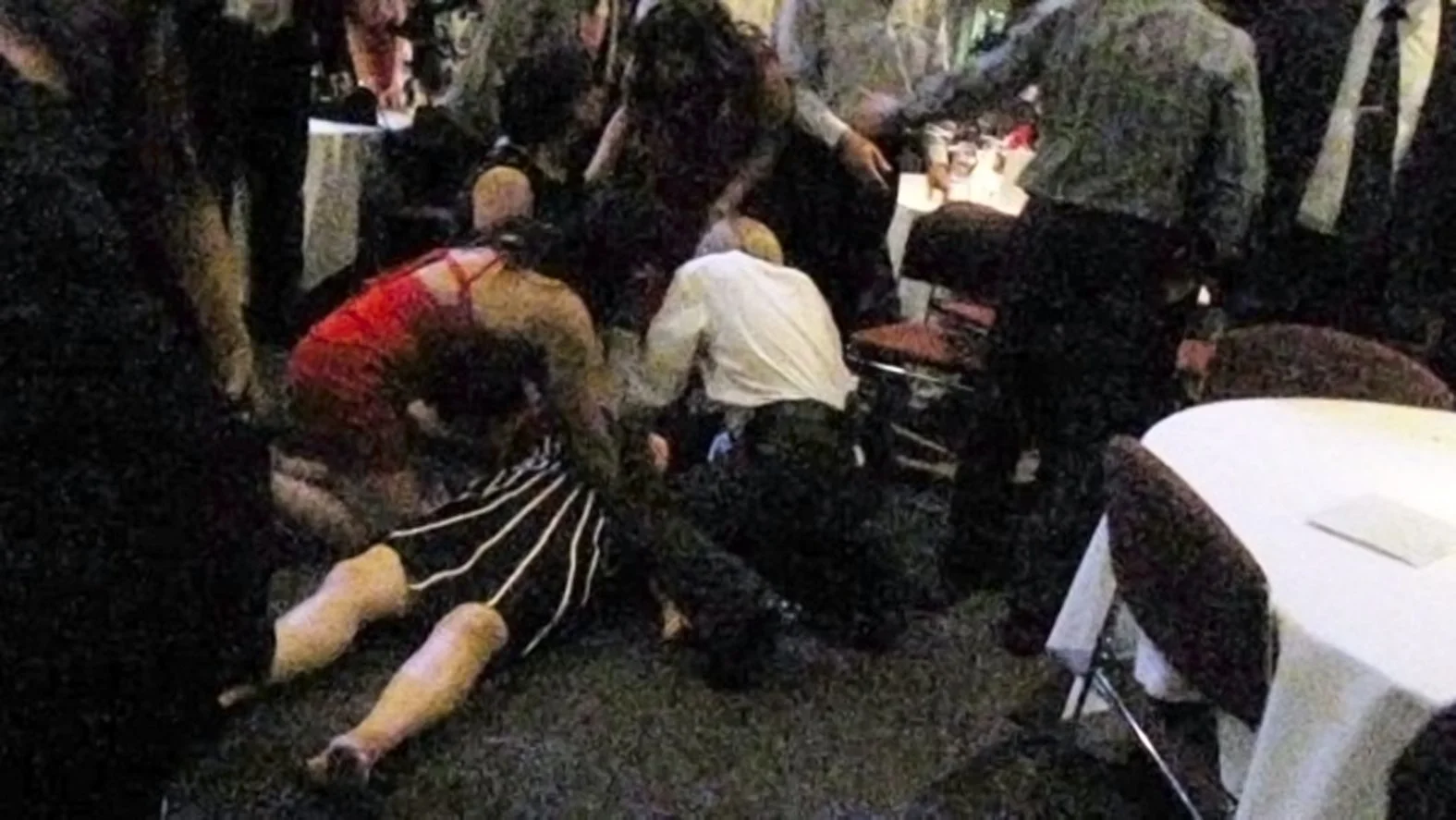
Within seconds of the attack, I took the photograph accompanying this post.
It shows people gathered around Zahra immediately after she was stabbed. Security personnel were already at the scene, and photography was quickly restricted.
This was the only still photograph I managed to take.
The photograph is technically poor. The lighting was difficult, the scene was chaotic, and there was no opportunity to adjust my camera or take another frame.
But its significance has never been about technical quality.
It is a visual record of a moment I witnessed firsthand.
Zahra died from her injuries. A celebration that had begun with music and dancing ended in tragedy, leaving three children without their mother.
The murder later became the subject of criminal proceedings in South Australia.
In 2012, Zioalloh Abrahimzadeh was sentenced to life imprisonment with a minimum non-parole period of 26 years for the murder of his estranged wife.
The case also prompted scrutiny of the authorities' response to Zahra's earlier reports of domestic violence and threats. A subsequent coronial investigation identified serious failures in the police response and made recommendations intended to improve the protection of people experiencing domestic and family violence.
Zahra's children — Arman, Atena and Anita — later established the Zahra Foundation in her memory, helping women and children affected by domestic and family violence.
For me, this photograph represents much more than the aftermath of a crime.
I remember a woman dancing at a New Year celebration. I remember the sudden violence that followed. And I remember the desperate screams of a daughter who had just witnessed the devastating consequences.
Those memories have never left me.
As a photographer and photojournalist, I have documented many events over the years. Some photographs are carefully composed. Others are made instinctively, in circumstances where there is barely time to react.
This photograph belongs to the second category.
I have kept it in my archive since 2010.
I also filmed parts of the celebration before the attack, including Zahra dancing, although I have not yet been able to locate the original footage among my older archives.
Sixteen years later, I have decided to share this photograph as a historical document and a personal account of what I witnessed that night.
It is also a remembrance of Zahra Abrahimzadeh, whose life was taken during what should have been an evening of celebration.
Photograph: People gather around Zahra Abrahimzadeh moments after she was attacked at a Persian New Year celebration at the Adelaide Convention Centre, 21 March 2010.
Editorial Use License (Digital Download)
This image is licensed for editorial use only.
Permitted use includes:
– News reporting
– Editorial articles and features
– Documentary projects
– Non-commercial online or print publications
The following uses are not permitted:
– Commercial use
– Advertising or promotional use
– Branding, marketing, or product endorsement
– Any use implying endorsement by a person, organisation, or entity depicted
No model or property releases are provided.
The buyer is responsible for ensuring compliance with applicable laws.
Copyright remains with the artist.
The listed price applies to standard editorial use by small or independent publications.
Use by major media organisations, print editions, or wide distribution requires an extended license.